
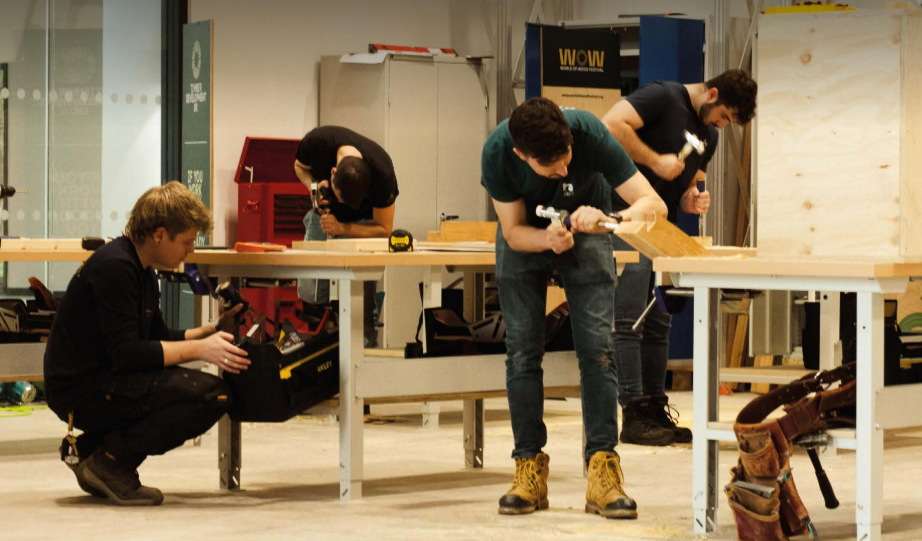
As Steve Bertasso, Associate Professor at NMITE illustrates, skills development in timber construction has become a vital part of the UK’s wider sustainability efforts
Once regarded as a specialised niche, timber is now at the heart of the shift towards low-carbon, modern methods of construction (MMC). As the industry advances, so must the skills of the workforce. Institutions like New Model Institute for Technology & Engineering (NMITE) and its Centre for Advanced Timber Technology (CATT) are ensuring education stays in step – linking sustainability, engineering, and practical craftsmanship.
The growing importance of timber skills
The UK’s sustainability education landscape is rapidly expanding. Courses on carbon literacy, circular economy principles, and green building standards are common, but timber remains underrepresented in sustainability education, presenting a unique opportunity for sector growth. Understanding how wood behaves, how engineered timber products perform, and how supply chains link forest to fabrication is essential for future-ready designers, engineers, and builders.
Timber-focused skills are part of the wider sustainability ecosystem but require a deeper understanding of timber literacy and emerging product knowledge. While sustainability courses cover principles of embodied carbon and energy efficiency, timber-specific courses include design detailing, moisture performance, structural systems, and offsite manufacturing principles to develop comprehensive expertise. NMITE plays a vital role between emerging research and trade groups seeking courses to upskill for a more sustainable building market. As a Skills Hub training provider for STA members, NMITE delivers sector-specific education to help expand the workforce needed to meet the UK’s net-zero targets.
A changing skills landscape
Timber provides both opportunities and challenges. While its environmental benefits and performance potential are well documented, the skills required to design, manufacture, and construct effectively with timber are still developing across the sector. From digital modelling and offsite fabrication to installation and lifecycle assessment, the industry needs education pathways that are practical, accredited, and aligned with modern sustainability goals.
As MMC adoption and the net zero agenda accelerate, education providers and industry bodies must collaborate to close this skills gap – ensuring the workforce is equipped not only to work confidently with timber but also to apply sustainable thinking across all parts of construction. Building this integrated skill set is crucial to fulfilling the ambitions outlined in the UK’s Timber in Construction Roadmap and broader green-skills strategy.
NMITE: educators at the forefront
NMITE plays a vital role here, bridging the gap between new research and practical applications of new building strategies in timber. CATT in Hereford is changing how higher education supports the timber industry. Through its Timber Technology, Engineering and Design (Timber TED) and retrofit courses, groundbreaking timber research, and the recent launch of a timber-focused BSc (HON) in Construction Management, NMITE provides flexible, industry-approved training for professionals and new entrants to the sector.
Developed in partnership with Timber Development UK (TDUK) and Edinburgh Napier University, the Timber TED courses combine academic rigour with hands-on learning. Each short course covers areas such as sustainability, materials science, design principles, and construction techniques. This industry-guided content addresses the growing skills needs and informs the new degree programme, ensuring students enter the workforce prepared for the constantly evolving landscape of sustainable construction.
NMITE’s broader ‘learning by doing’ philosophy aligns with the building industry’s preference for action-based education methods. Participants apply sustainable design principles directly to real-world projects, demonstrating either opportunities for improvement or examples of future-focused design.
Researching the future – from forest to frame
The Building from English Woodlands research exemplifies realworld initiatives in education. Completed in early 2025, this project examined how underused English-grown timber species can help meet the UK’s construction demands. By connecting forestry, supply chains, and structural applications, the project is shifting perceptions of homegrown timber as a valuable natural building resource, with an example already in practice.
The Skills Hub at NMITE’s Blackfriars campus is a mass timber building constructed from glulam beams and prefabricated panels, providing a sustainable construction solution. The structure, already used in CPD and degree-level teaching as a live example, features a hybrid beam made with local materials based on recent research (English Ash and Scottish Spruce). The hybrid design strategically uses hardwoods to maximise strength while reducing overall resource consumption and embodied carbon, without compromising performance.
A call for continued collaboration
For professionals seeking to improve their sustainability credentials, timber skills education now presents a logical next step. Whether you’re an architect exploring low-carbon materials, an engineer transitioning to MMC, or a contractor aiming to diversify into offsite manufacture, emerging programmes like NMITE’s Timber TED offer a pathway that links theory with practice.
The UK’s timber future depends on collaboration between industry, educators, and policymakers. The industry, working through organisations like the STA, identifies training gaps in the workforce: educators, such as NMITE, research and develop new typologies and create the learning infrastructure and the broader sustainability community ensures that the principles of low-carbon design support every stage of development.
Timber-skills development is increasingly vital to the UK’s sustainable construction strategy. It connects craftsmanship and innovation, aligns forest management with building design, and offers practical avenues for professionals to help achieve a net zero future. As an advocate for continuous improvement in education, the timber-skills agenda exemplifies what modern sustainability learning should be: hands-on, collaborative, and rooted in real-world impact. Through the combined efforts of organisations like NMITE, TDUK, and the industry, the UK is building not only with timber – but with knowledge, resilience, and purpose.