
Peter Fisher, Director at Bennetts Associates, explores the design and material decisions behind London’s ambitious new campus at Timber Square
When Landsec set the brief for Timber Square in 2019, it was unusually clear. The design was to prioritise reuse, visibly reversible structural joints and biogenic materials. These principles shaped an architecture that is materially honest, low-carbon and practical to deliver – a model for how mainstream commercial projects can adopt timber at scale.
Located in Bankside, close to Tate Modern, Timber Square is a mixed-use redevelopment comprising two buildings – a partially retained, refurbished and extended former 1950s printworks (the Print Building) and a new 15-storey building (the Ink Building). Forming a new sequence of public spaces between them, the two buildings total around 380,000sq ft, including 365,000 of office space plus retail, leisure and support uses. Together they form an ensemble that unites reuse, innovation and wellbeing within the dense fabric of central London.
Architectural vision and how mass timber shaped it
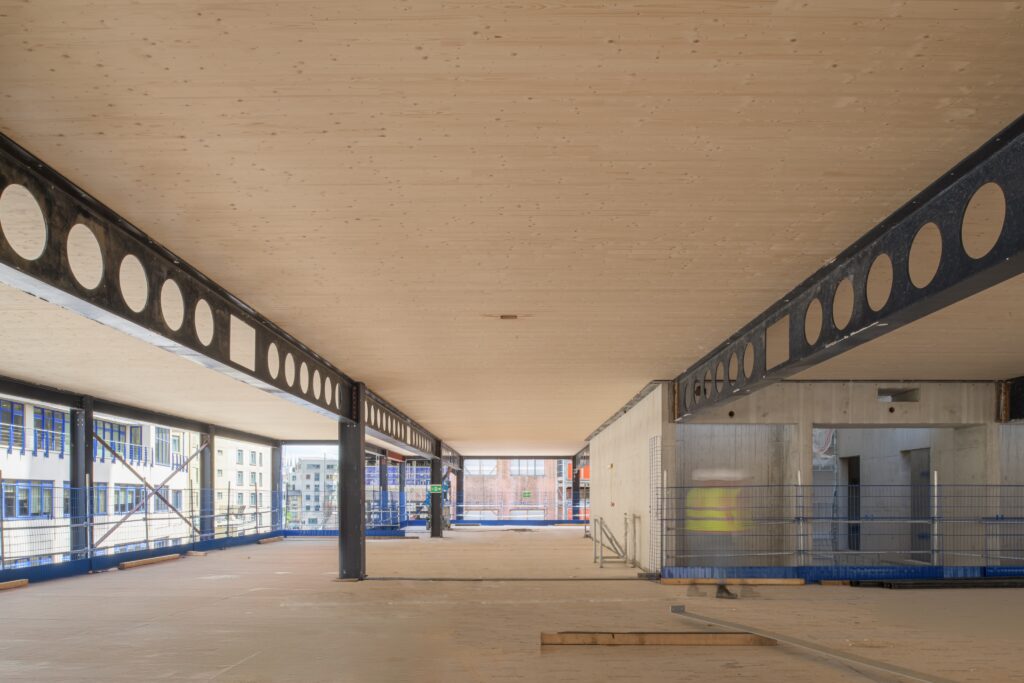
Bennetts Associates architectural ambition was to achieve a characterful authenticity that echoed the expedience of the area’s industrial past. Here, that pragmatism is reinterpreted through carbon discipline and material restraint: an exposed structure, minimal applied finishes and honesty about how things are made. The decision to use mass timber was fundamental to this vision. Instead of concealing the structure behind layers of material, the design reveals it. The existing concrete frame is retained and extended; the new building is expressed through a hybrid steel and cross laminated timber frame (CLT). The result is a calm and legible architecture where joints and materials are part of the language.
This restraint has environmental and human benefits. By minimising finishes, the design avoids visual noise and unnecessary complexity, creating workplaces that feel comfortable and intuitive. Natural materials, light and planting all contribute to a quieter sensory environment. The same decisions that reduce carbon also support wellbeing, producing buildings that are calmer and easier to understand.
Design and structural ambitions enabled by the hybrid approach
Timber’s lightness unlocked the potential of the retained printworks. Its foundations, designed for heavy presses, could carry four additional storeys without significant strengthening. A lightweight steel truss with CLT floor planks reduced the overall structural weight by about a quarter compared with a conventional concrete frame. The hybrid approach also enabled reversible connections, modular assembly and a high degree of prefabrication.
The benefits were equally visible during construction. A concrete delivery truck typically carries about six cubic metres of material – each truckload of CLT arrived with 45 cubic metres of prefabricated planks. Temporary edge protection was screwed into each plank while still on the truck bed, meaning the panels could be lifted directly into place with the protection already fitted – a sequence that was quiet, safe and efficient. On both buildings the steel primary structure has beams at 6m centres, with 12m-long CLT planks spanning between. These are simply supported and not acting compositely, which aided construction as well as future adaptability.
To build confidence at this scale, Landsec funded full-scale fire tests of a structural bay for each of the two buildings. Developed with the project team and insurers, the tests validated the hybrid system’s fire performance and should help to establish benchmarks for future schemes. While the scheme pre-dated the ‘Mass Timber Insurance Playbook’, the process closely mirrored the methodology later set out within it, providing evidence-based reassurance to the client and underwriters alike. That willingness to test, prove and share data has been as important as the design itself in moving the sector forward.
Carbon benefits, wellbeing and long-term performance
The combined effect of reuse and hybrid construction has significantly reduced the scheme’s upfront carbon compared with a typical London office. Altogether, around 6,500 cubic metres of CLT have been installed, sequestering about 5,000 tonnes of CO₂. The scheme’s upfront emissions are in the process of being verified with as-built data and are on target to reach around 500 kilograms of CO₂ per square metre (Modules A1–A5).
The resulting structure is an efficient, adaptable framework that achieves strength, lightness and circularity in equal measure, yet its long-term performance will be judged not only in the resourceful use of materials but also in the quality of space it provides.
Timber’s natural texture and scent create a sense of warmth rarely found in large office buildings. Daylight, muted colour and planting on every level bring a biophilic calm that benefits concentration and comfort. These choices align with research on neurodiversity and sensory wellbeing, showing that legible, coherent spaces are easier to navigate and less likely to cause fatigue. In this sense, environmental efficiency and human wellbeing reinforce one another rather than compete.
Lessons for scaling timber in the UK
Timber Square shows that large-scale timber projects are now possible within today’s commercial, regulatory and insurance frameworks. Landsec’s early engagement with insurers and willingness to test full bays in controlled conditions have created precedents from which others can benefit. Each major project adds to a collective body of evidence that will inform and support the success of future developments.
Scaling timber in the UK will depend on this kind of open collaboration between clients, designers, manufacturers and insurers. While technical challenges are largely resolved, confidence still grows through experience. Every truck that carries more material with less disruption, every plank that lifts cleanly into place, and every space that brings character and delight to the everyday brings the industry closer to routine acceptance of timber as a mainstream structural material.
Timber Square is, in that sense, a collaborative exercise in how to make progress responsibly. It combines three imperatives that are reshaping construction: reuse before rebuild, biogenic materials before extraction and verification before assumption. Timber Square is due for completion in Q1 2026 and is currently by volume set to be the UK’s largest CLT commercial development and has the tallest hybrid frame. Its architectural clarity and technical discipline show that low-carbon design can be commercially viable and human in character. Timber is not an alternative material but a better and more human way to build.